Agreements
Agreements are documents that every visitor has to read and digitally sign before they finish checking in at your reception. Most companies use them for non-disclosure agreements, site-specific health and safety instructions, fire and evacuation procedures, IT acceptable-use policies for contractors, or short visitor codes of conduct. With a Visitor Management System (VMS) like Vizito the entire process happens on the tablet at the front desk, so the signed copy is stored centrally and you no longer have to chase paper forms or keep a binder behind reception.
Capturing agreements digitally also helps with GDPR/AVG compliance: every signature is timestamped, linked to the visitor record and kept for as long as your retention policy allows. You can prove who signed which version of the document, on which date, which is hard to do with a clipboard. Agreements are set up once under “Account settings” > “General” and then assigned to the visit types they apply to, so a courier who only drops off a parcel does not have to sign the same NDA as a contractor who will work on site for the day.
You need the latest version of the Vizito tablet app to use agreements.
The three agreement types
- Document - text that you write and edit in the backoffice, including images and custom styling. You can enter a version for every language you support. This is the right choice for short policies that you want to edit yourself.
- Video - a video that the visitor has to watch before being able to proceed with the sign in. Video agreements are ideal for safety inductions, factory-floor instructions or warehouse rules where a short clip explains the procedure better than a wall of text. You can add a descriptive text that is shown under the video player.
- PDF - a PDF document that is presented to the visitor exactly as it is. Use this when legal or compliance has already produced a formal, branded document.
Video and PDF agreements are uploaded to Vizito, which stores the file for you. You do not host them yourself.
Add an agreement
-
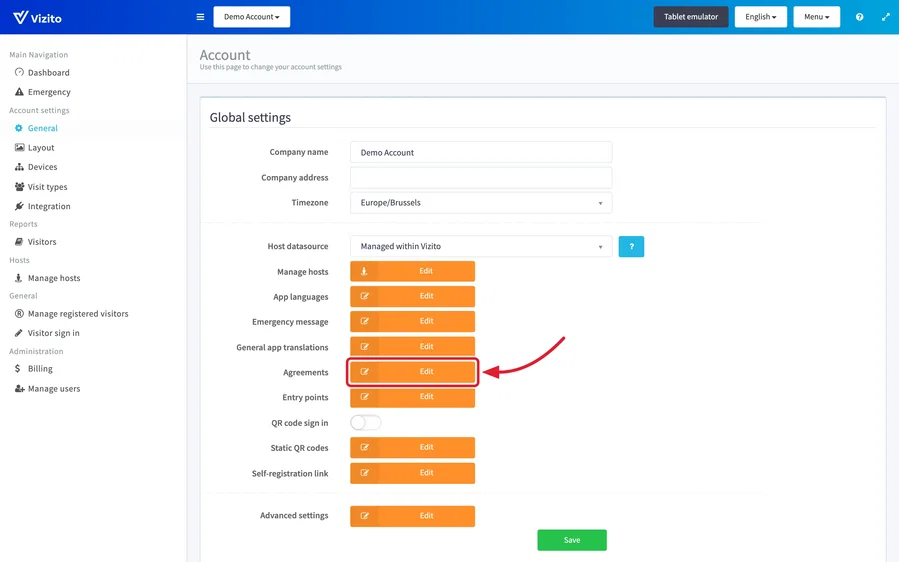
Open the Vizito backoffice and select “Account settings” > “General” in the left menu.
-
Under “Location settings”, find the “Agreements” row and click “Edit”.
-
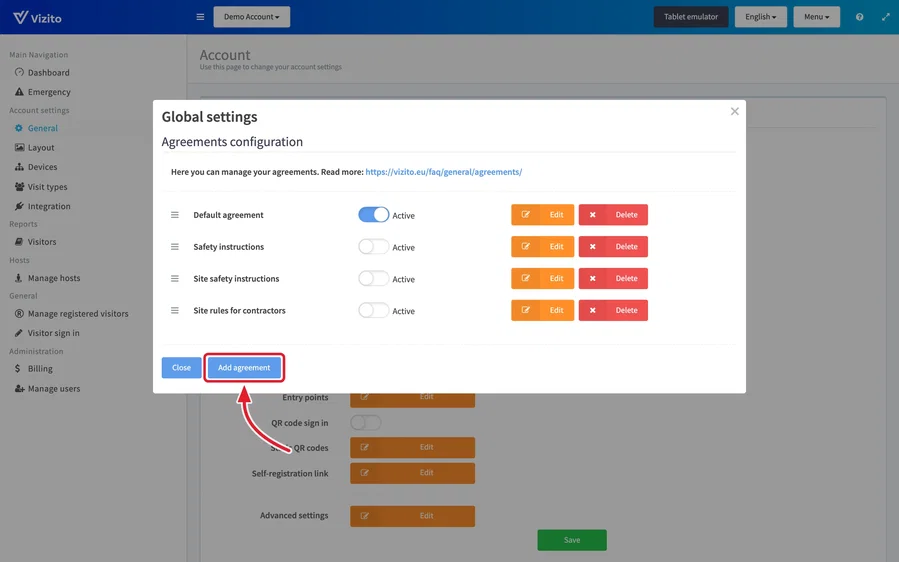
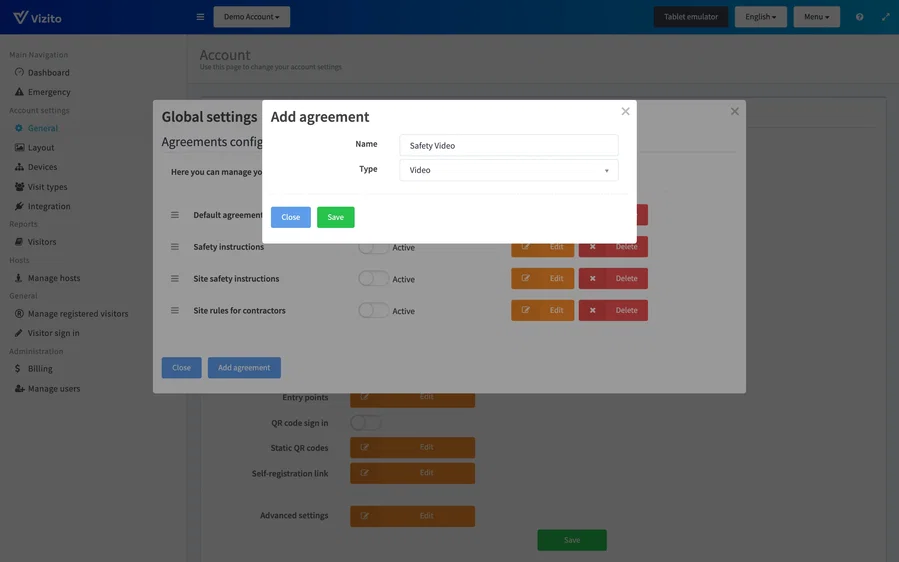
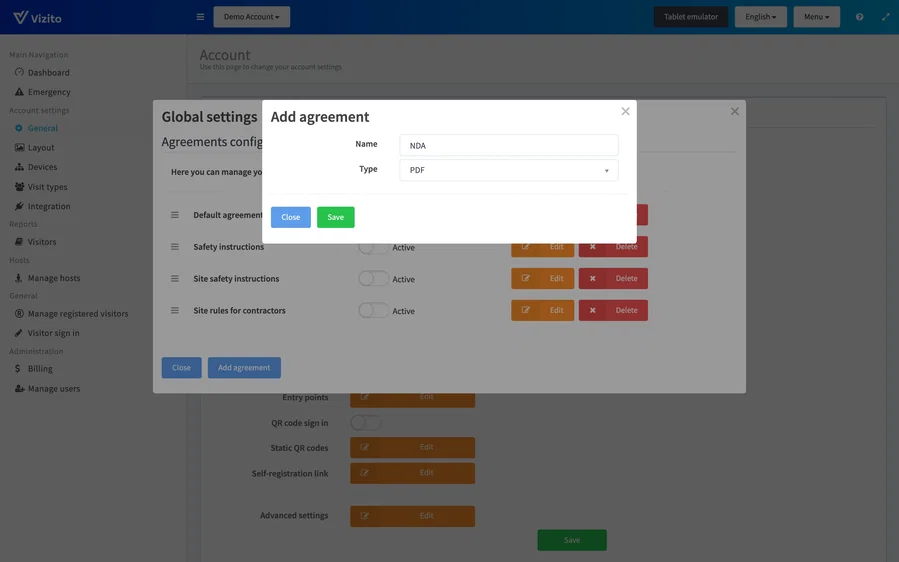
Click “Add agreement” at the bottom of the “Agreements configuration” window.
-
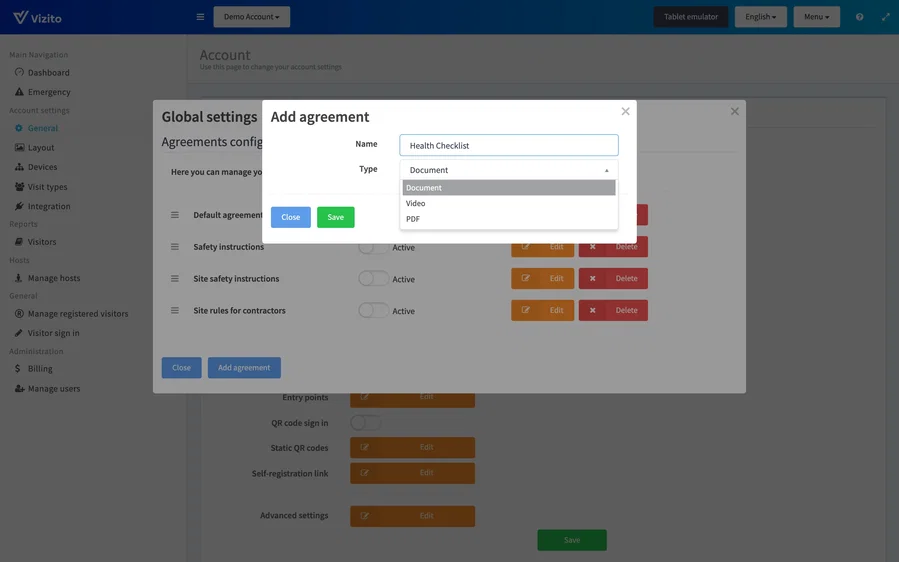
Enter a name and choose “Document”, “Video” or “PDF” under “Type”. Choose carefully: the edit screen has no Type field, so switching type later means adding a new agreement.
-
Click “Save”. The agreement is added to the list, ready to be filled in.
Configure an agreement
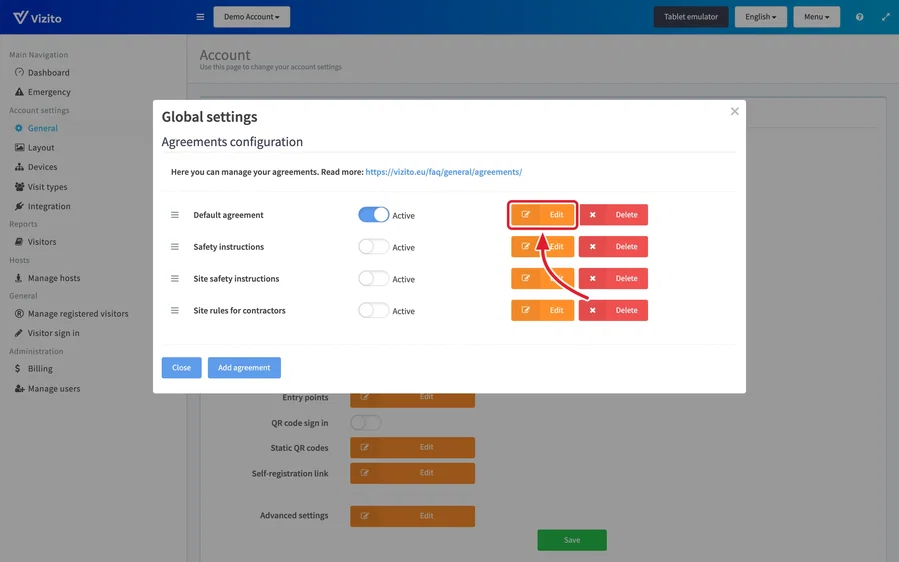
Click “Edit” next to the agreement to open its settings, and click “Save” when you are done.
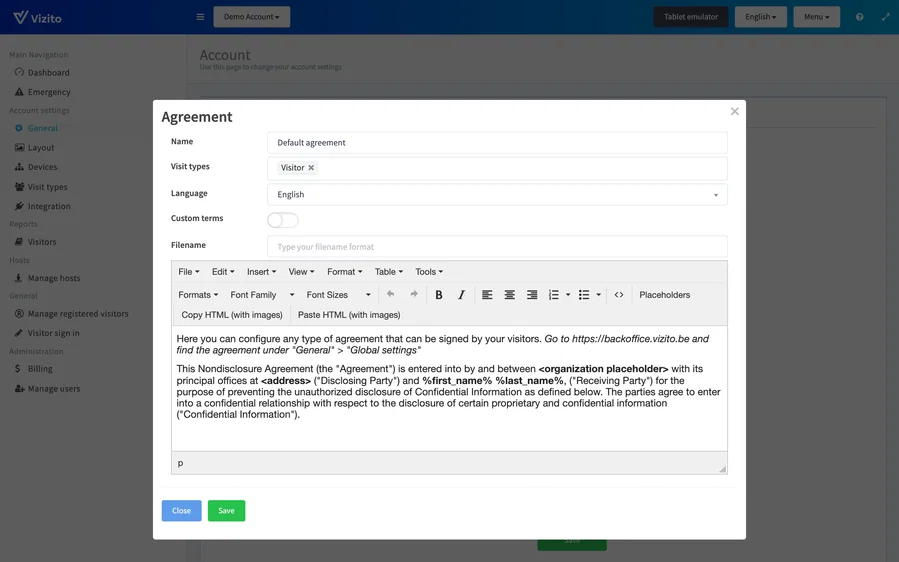
Every agreement, whatever its type, has these settings:
- Name - the name you gave the agreement. You can change it here.
- Visit types - the visit types this agreement applies to. One agreement can cover several visit types, and visitors only get the agreements that belong to the visit type they picked.
- Language - the language you are editing. Text and uploaded files are stored per language, so switch the dropdown and repeat for every language your app offers.
- Custom terms - switch this on to make the agreement expire. A field called “Expires after days” appears, where you specify after how many days the document expires and has to be reviewed again.
Filename sets the name of the signed PDF copy that Vizito sends by email. You can use the placeholders %agreement_name% for the name of the agreement, %first_name% and %last_name% for the name of the visitor, and %signed_in_day% / %signed_in_month% / %signed_in_year% for the date of signature. Video agreements do not have this field.
Document
Write the text in the HTML editor below the settings. The toolbar has the usual formatting options, plus a “Placeholders” button that inserts visitor details such as first name, company or email into the text. Switch the “Language” dropdown to enter the text for another language.
Video
Choose “Video” as the type when you add the agreement.
- Select the language you are uploading for.
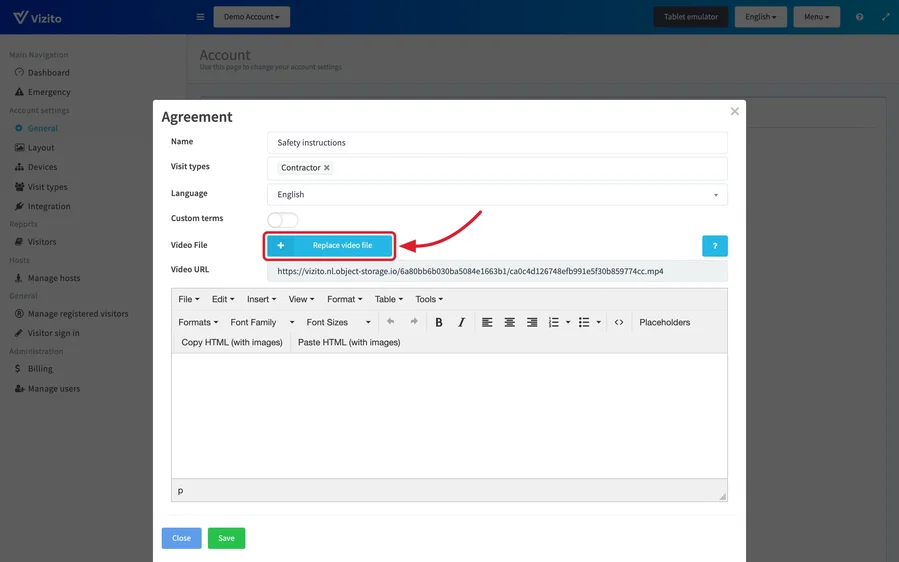
- Click “Upload video file” in the “Video File” row and pick the file. Vizito accepts mp4, webm, ogg and mov files up to 10 MB.
- Wait for the upload to finish. The read-only “Video URL” field then shows where the file is stored, and the button changes to “Replace video file”.
- Optionally type a descriptive text in the editor underneath. Visitors see it below the video player.
Switch on “Enforced” if the visitor has to watch the video all the way through before they can continue.
Choose “PDF” as the type when you add the agreement.
- Select the language you are uploading for.
- Click “Upload PDF file” in the “PDF File” row and pick the file. Only PDF files are accepted, up to 10 MB.
- Wait for the upload to finish. The link to the stored file appears under the button, which changes to “Replace PDF file”.
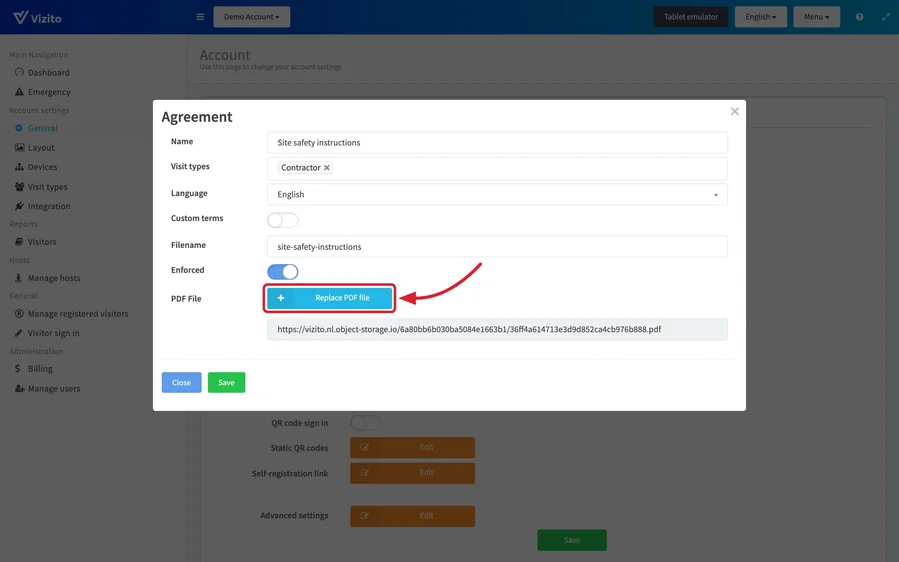
A PDF agreement has no text editor, so it cannot have a descriptive text. Visitors read the document itself.
Switch on “Enforced” if the visitor has to page through the entire document before they can continue. Use it for documents that have to be read rather than skipped past, such as a safety induction or a site instruction.
Manage your agreements
The “Agreements configuration” window lists every agreement in your account:
- Use the toggle next to a name to activate or deactivate an agreement without deleting it. Inactive agreements are not presented to visitors.
- Click “Edit” to change an agreement, or “Delete” to remove it.
- Once you have more than one agreement, a drag handle appears in front of each name. Drag a row to change the order of the list.
After the visitor signs
Once the visitor has signed, the agreement is stored together with the rest of the visit record. You can review past signatures from the backoffice, export them for an audit, and send the signed copy by email to the visitor or the host. Because every signed agreement is tied to a specific document version, an update to the text only applies to visitors who sign in after the change, which keeps your audit trail consistent.
If a visitor has already signed a document and returns within the validity period that you configured, Vizito recognises them as a known visitor and will skip the agreement to keep the sign-in flow short. As soon as the validity expires, the agreement is presented again automatically.
If you have any questions on agreements, feel free to get in touch with us.