Oct 15, 2026
Who Is on Site Right Now? An HSE Manager’s Guide to On-Site Visibility
AI and automation are taking over more and more routine tasks at the front desk. In this article, we discuss what that means for the future of receptionists and why the personal touch still matters.
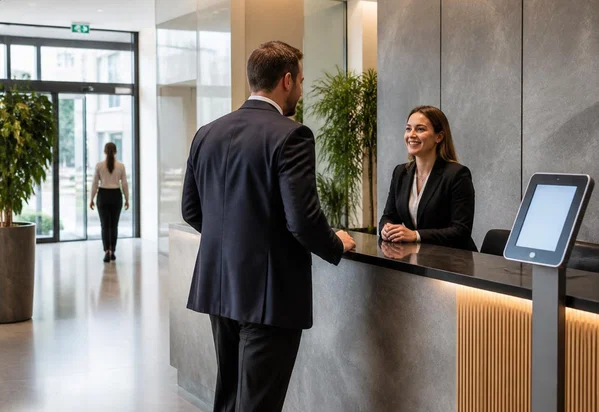
A question on many people’s minds is what impact AI will have on their job. In most companies, a lot is already changing with the arrival of artificial intelligence (AI) and automation. And you often notice it the moment you walk into a company.
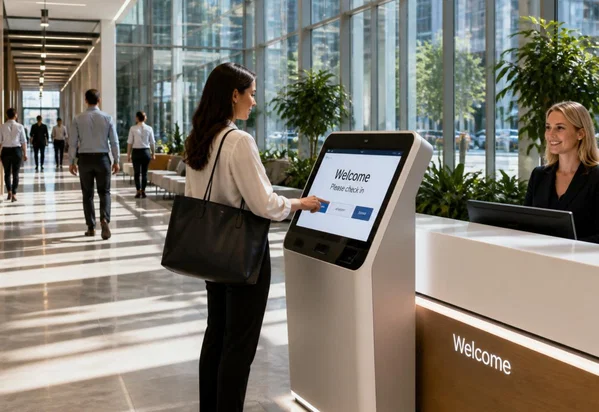
In the past, you were greeted in the lobby by a receptionist, who signed you in on paper and called your host. Your host then came to the front desk to collect you. Today, visitors increasingly check in digitally, a visitor badge is printed automatically and the right employee is notified immediately that you have arrived. Often, no receptionist is involved at all.
The question arises: is a human receptionist still needed? Are we moving towards a future with only AI receptionists, or will there always be a need for personal contact and human hospitality?
In this article, we discuss which receptionist tasks are already commonly automated, what AI can and cannot do, and why human receptionists remain indispensable.
Receptionists are true multitaskers. They welcome visitors while the phone rings, answer an email in between, schedule an appointment and keep an eye on whether everything at the desk is running smoothly. They constantly have to switch, keep the overview, solve problems and, all the while, radiate calm and professionalism.
To support them, companies are increasingly using digital technologies and AI at the front desk. Repetitive and administrative tasks in particular are being automated. That way, the front desk can be organised more efficiently and receptionists can focus on the visitors in front of them.
The following front desk tasks are already often fully or partially automated.
Visitor management used to involve a lot of administrative work. The receptionist checked appointments, signed visitors in manually, printed badges, notified employees and showed guests the way. Afterwards, the visitor data also had to be processed and stored correctly.
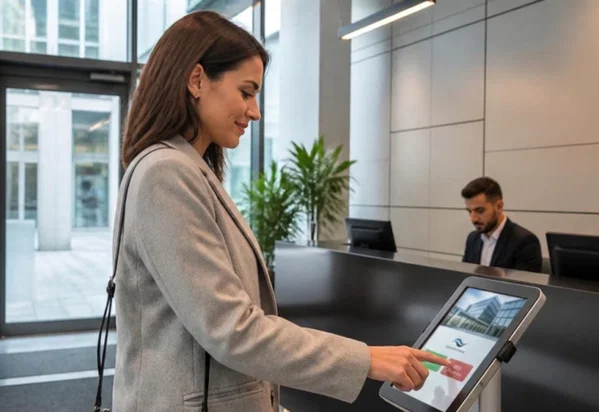
Today, digital visitor management systems automate a large part of that process. Visitors can be pre-registered and check themselves in on arrival via a kiosk or tablet. The system verifies the appointment, prints a badge and automatically sends a notification to the right employee.
Additional administration can also be handled by a Visitor Management System (VMS). During check-in, visitors can, for example, digitally sign a non-disclosure agreement (NDA) and read and confirm safety or privacy instructions. Based on the visitor type, the system automatically presents the right documents and instructions.
Many organisations use systems to answer phone calls automatically. Traditional systems work with fixed menus and pre-recorded messages to route callers to the right department. AI-driven voicebots go a step further: they can process spoken questions, answer frequently asked questions, take messages and help schedule appointments. As a result, the receptionist has fewer standard calls to handle.
Email remains an important communication channel in most companies. According to Microsoft’s Work Trend Index 2025, an employee receives an average of 117 emails per working day. That is a lot, and reading and answering all those emails naturally takes up a great deal of time.
Thanks to AI, receptionists no longer have to review and forward every incoming message in the general mailbox themselves. An AI assistant can analyse messages based on their content and automatically assign them to categories such as sales, support and scheduling. The system can also prioritise messages or forward them to the right department or employee. In addition, AI can draft a reply or handle simple standard questions on its own.
Scheduling appointments manually is a lot of work. Calendars have to be compared, meeting rooms booked in time, confirmations sent, and with every change or cancellation the whole process starts again.
Many companies use an AI receptionist that largely automates these tasks. Through a link with digital calendars and customer data, the system finds available time slots, books appointments and automatically sends a confirmation and reminders by email or text message.
Receptionists are often asked the same questions by phone, email, online chat or at the desk. Think of questions about opening hours, prices, services, directions, parking options or the way to a meeting room or the restroom.
Part of those questions is now often answered automatically by AI systems. That can be via a chatbot on the company website, a voicebot on the phone, an AI assistant in the mailbox or a digital kiosk on site.
Receiving and registering parcels is also increasingly done digitally, using scanners, smart lockers and automatic notifications. The courier or receptionist scans the parcel, after which the system links the delivery to the right employee. They immediately receive a notification by email, Teams or text message.
One advantage of digital visitor management is that it can be integrated with access control systems. As a result, part of the identity and security checks in companies now often happens automatically.
For example, the system can scan an ID document, compare the data with the visitor list and automatically print a personalised badge. Some organisations also use facial recognition to verify the identity of employees and visitors.
After the identity check, the system determines which areas the visitor may access and for how long, for example with a temporary badge or QR code. When a visitor tries to check in at the wrong location or uses an expired badge, the system can deny access and alert the front desk or security.
Digital systems also keep track of who is in the building at any given time. That provides an auditable log and helps to quickly draw up an up-to-date attendance list in the event of incidents or evacuations.
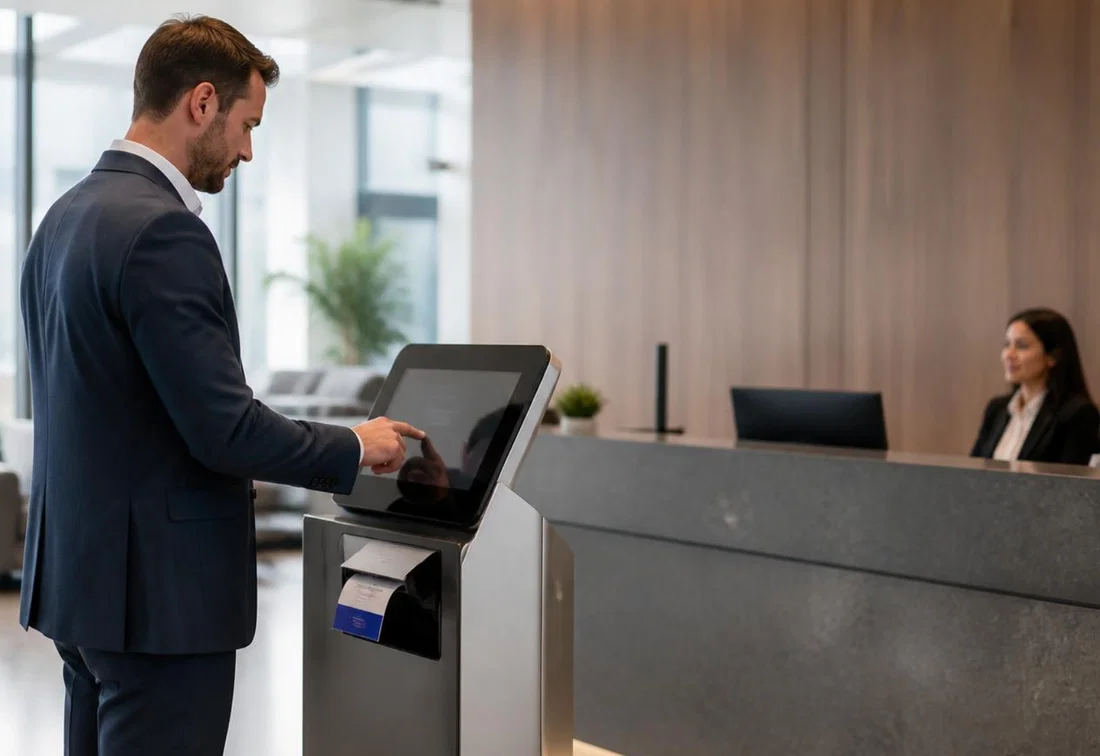
An AI receptionist clearly has its strengths. The system works around the clock, without breaks, holidays or rest. Customers do not have to wait for a call or email to be answered. A lot of work can be done at once, and quickly. But although AI excels at performing repetitive tasks, it also has important shortcomings compared to a human receptionist. An overview:
| What AI does well | What AI cannot do (well) |
|---|---|
| ● Be available 24/7, including outside office hours | ● Provide a personal welcome |
| ● Answer standard questions quickly | ● Handle complex or unexpected situations |
| ● Perform repetitive tasks | ● Interpret context, nuance or body language |
| ● Help several visitors or callers at once | ● Show genuine warmth or empathy |
| ● Apply information and procedures consistently | ● Sense conflicts and de-escalate appropriately |
| ● Communicate in multiple languages | ● Build a relationship of trust |
| ● Collect data and recognise patterns | ● Appropriately support emotional visitors |
| ● Reduce the workload of receptionists | ● Function during internet or technical outages |
Yes, AI is available 24/7. Yes, AI is fast, efficient and can process several requests at once. And yes, AI never gets impatient when it is asked the same question for the hundredth time.
But efficiency is not everything. Workplace expert Rebecca Moulynox, General Manager of Great Place To Work ANZ, illustrates this strikingly with an example in a post on LinkedIn:
“There is a reason people walk past the free Nespresso machine in the office kitchen and pay eight dollars, yes eight dollars, for a flat white from the barista who knows their name and their order. It is slower. It is more expensive. It makes no logical sense whatsoever. And they do it anyway, every single morning, because the personal touch matters more than the efficient option.”
- Rebecca Moulynox
At the company front desk, too, that personal touch remains essential. There are three reasons for that:
A front desk is much more than an administrative point of contact. It is often the place where visitors form their first impression of an organisation. The receptionist is usually the first human point of contact for customers, candidates, suppliers and other guests.
As a representative of the company culture, the receptionist radiates hospitality, professionalism and trust. A visitor who is greeted warmly and given personal attention feels welcome and is quicker to form a positive image of the organisation. That can lay the foundation for a strong and lasting relationship.
What if a frustrated customer needs to be reassured? If a candidate is visibly nervous? Or if a conflict arises with a supplier?
In such situations, empathy and emotional intelligence are indispensable. A human receptionist can interpret tone, facial expression and body language to recognise that someone is nervous, confused or upset. They can then reassure the visitor and adapt their communication to the person and the situation.
AI can recognise certain emotions or language patterns and imitate an empathetic response, but it has no genuine human understanding. Especially in sensitive situations, personal contact therefore remains hard to replace.
AI copes well with predictable situations and predefined procedures. With unexpected requests or complex problems, however, human insight is often needed to assess the context and make a decision at the right moment.
Receptionists use discretion, experience and common sense to recognise suspicious or unusual behaviour. They can judge when a rule has to be applied strictly and when some flexibility is appropriate. Moreover, they know how to handle confidential information and when to escalate a problem to a manager, a security officer or another responsible person.

The short answer: no, but the role will look different.
The US Bureau of Labor Statistics counted more than 1 million receptionist jobs in 2024. For the period up to 2034, the bureau expects little or no change in the total number of jobs.
So the profession is not disappearing overnight, but that does not mean nothing is changing. The role is increasingly built around tasks where human presence genuinely adds value. A stable total also does not rule out individual companies cutting receptionist positions.
AI is here and it is not going away. As the technology improves, more and more administrative and repetitive front desk tasks will be automated. The future most likely lies in a hybrid front desk, where AI processes predictable tasks and the receptionist focuses on personal contact and more complex situations.
| Tasks for AI | Tasks for the receptionist |
|---|---|
| ● Registering visitors digitally | ● Welcoming visitors personally |
| ● Answering frequently asked questions | ● Solving complex or unexpected questions |
| ● Processing phone calls | ● Handling sensitive conversations |
| ● Scheduling and confirming appointments | ● Assessing exceptions |
| ● Sorting emails and drafting standard replies | ● De-escalating complaints and conflicts |
| ● Recording and processing data | ● Assisting VIPs and visitors with special needs |
| ● Sending automatic notifications | ● Recognising suspicious or unusual behaviour |
| ● Executing standard procedures | ● Overseeing the technology in use |
By automating the background work, the receptionist can spend more time on the people and situations that need personal attention. The receptionist thus shifts from executor of standard tasks to coordinator of the entire visitor experience.
In some organisations, the role is therefore becoming broader and the receptionist also takes on tasks in hospitality, office management, access management or workplace experience. Job titles such as front office coordinator and workplace experience coordinator reflect that development.
Read also: Essential duties and responsibilities for a receptionist
A hybrid front desk does not automatically mean that all current jobs will be retained. When AI and automation take over a larger share of the work, one receptionist can manage more visitors, phone calls and administrative processes at the same time. Some companies will therefore be able to operate with fewer front desk staff.
That will mainly be the case at locations with predictable visitor flows and little need for personal guidance. Companies may then choose, for example, to staff the desk only during busy hours, to have one receptionist support several locations remotely or to call in an employee only for exceptions.
The impact will not be equally large everywhere, however. In offices where hospitality, security and personal contact are central, a human receptionist remains important. Think of large headquarters, healthcare institutions and organisations that receive many customers, candidates or international guests.
The receptionist of the future does not have to compete with AI, but must learn to use the technology to their own advantage. By strengthening human skills, building digital knowledge and broadening their own role, receptionists can prepare for a changing profession.
According to the World Economic Forum’s Future of Jobs Report 2025, skills such as analytical thinking, resilience, flexibility, leadership and collaboration remain important, even as technology is profoundly changing the workplace.
Those are exactly the skills that make the difference for receptionists and enable them to:
Read also: Receptionist Skills: 12 Essential Qualities
Receptionists do not have to compete with AI, but can learn to use the technology to their advantage. Those who work smoothly with visitor management systems, chatbots and digital scheduling tools can handle repetitive tasks faster and free up more time for personal contact.
Overseeing those systems is also becoming more important. Someone has to check automated answers, correct errors and step in when AI misunderstands a question. Receptionists who learn to set up, monitor and adjust this technology make themselves extra valuable. They do not need to become IT experts for that: a good basic level of digital knowledge and the willingness to learn new applications are already an important first step.
Receptionists can broaden their role with knowledge of, for example, office management, hospitality, access management or workplace experience. That way, their work shifts from performing separate standard tasks to coordinating the entire visitor experience.
That can offer opportunities to grow into roles such as office manager, front office coordinator or workplace experience manager. Employers also bear responsibility here: they must invest in training and give employees enough time and support to learn to use new technology.
Receptionists need not fear that AI will make their profession disappear entirely, but they do have to take into account that their role is changing profoundly. Routine tasks such as registering visitors, scheduling appointments and answering standard questions are increasingly being automated.
But technology cannot simply take over all the human aspects of front desk work. Personal attention, empathy, flexibility and human judgement remain essential for a warm welcome and for resolving complex, sensitive or unexpected situations. The most likely future is therefore a hybrid front desk, where humans and AI complement each other.
Receptionists can prepare for that by strengthening their human skills, learning to work with AI and broadening their knowledge and range of tasks. The receptionist of the future may spend less time checking in visitors, but all the more on a warm and personal welcome.
Would you also like to spend less time registering visitors and more on a warm welcome? Try Vizito free of charge for 14 days. Chat with us or book a demo and discover what digital visitor management can do for your front desk.
 Hosted in Europe
 ISO 27001 Certified
 GDPR compliant
 249+ reviews
 No credit card required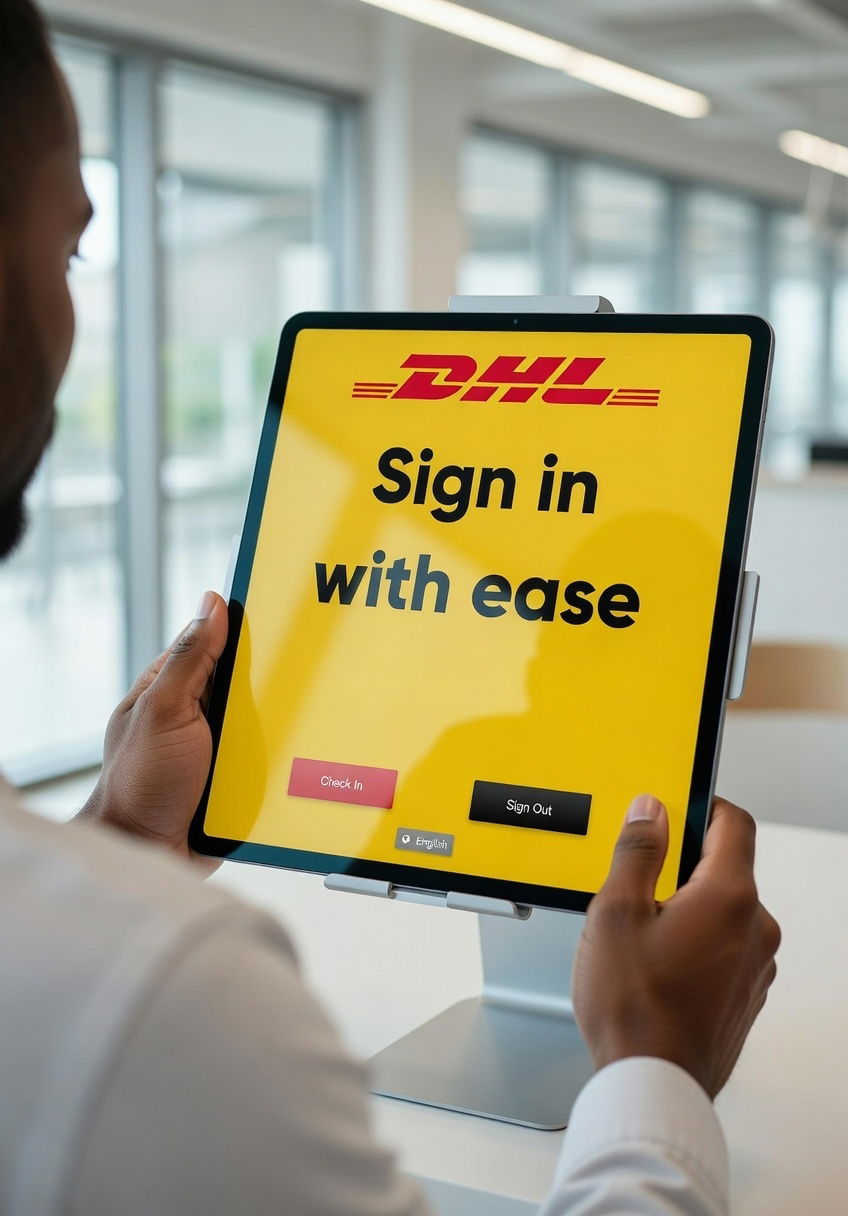
Our chat could not load
A content blocker or privacy extension is blocking client.crisp.chat, the service that runs our chat. Allow that address and try again, or reach us another way.
Contact us instead