Oct 07, 2026
Moving away from SwipedOn? What the new Terms of Service mean and how to switch
In this article, we explain how digital visitor management contributes to an organization that is audit-ready all year round. You will learn which visitor data to collect for a complete and reliable audit trail that is ready to support an ISO 27001, NIS2, GxP or customer audit from day one.
Written by Jill, Content Manager - Written: August 10, 2026

Imagine: your company is facing an audit. Do you find yourself, days or weeks before the appointment, scrambling to gather all the required evidence and records?
That is how many organizations approach it: they only start collecting documents once the audit has been announced. That approach leads to stress, missing evidence and inconsistent processes. In other words, it is not a formula for success.
Successfully preparing for an audit is not something you do right before the appointment, but all year round.
Whether it concerns ISO 27001, NIS2, GxP or a customer audit: you will have to demonstrate that your processes do not just exist on paper, but are also consistently applied in practice. Being audit-ready means that your organization has up-to-date policy documents, reliable logs, documentation, incident reports, clear responsibilities and quickly accessible evidence available all year round.
Visitor management plays a role in this as well. After all, digital visitor registration is more than a smooth check-in at the reception desk. The data you collect forms valuable audit evidence: visitor logs, contractor documentation, signed NDAs, safety instructions and evacuation records.
In this article, we explain how digital visitor management contributes to continuous audit readiness: being audit-ready all year round, without last-minute searching. Which data is immediately available in an audit-ready visitor log, and how does your visitor management system help with crucial audit requirements, such as retention and tamper-evident logs?
In this blog:
Being audit-ready means that your organization does not start collecting evidence just before an audit, but keeps processes, logs and documentation in order all year round. Continuous audit readiness is an approach in which audit preparation is part of daily operations.
In concrete terms, this means you can demonstrate at any moment that key processes are controlled, documented and reproducible. Auditors do not only look at what a policy document says. They also want to see how that policy is applied in practice. For example: who was granted access? When did that happen? Who approved it? Which documents were signed? And can you demonstrate all of that quickly and reliably?
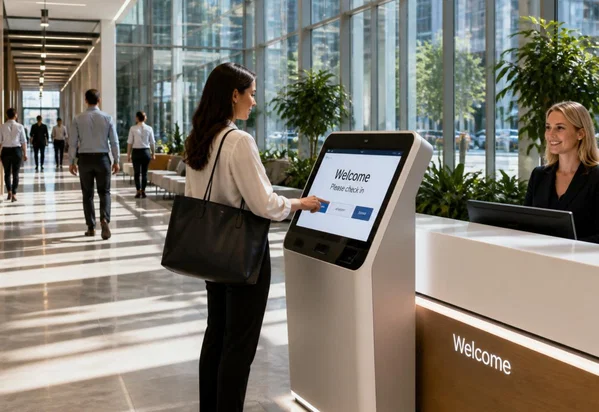
That is where digital visitor management fits in. A visitor management system (VMS) records this kind of data automatically. Documents such as NDAs, safety instructions, contractor information and evacuation records can also be linked to the visit.
This way, you always have an audit-ready visitor log and no longer need to gather visitor data after the fact when an auditor asks for it. The data is created automatically during the normal check-in process.
Visitor management is therefore not just an administrative task, but an important source of audit evidence. It does not automatically make your organization compliant with ISO 27001, NIS2, GxP or customer audit requirements, but it does support the evidence that auditors and customers need.

A well-configured visitor management system helps with one thing above all: answering practical audit questions quickly and reliably. Instead of having to look up data in paper logbooks, scattered spreadsheets or mailboxes, you can consult and export visitor information centrally.
Think of questions such as:
For ISO 27001, such data can help demonstrate who had physical access to your site, when and under whose responsibility. This supports controls around access management and information security.
For NIS2, visitor management helps you keep better track of external access, contractors and suppliers. This is relevant for risk management, incident response and the security of critical processes.
For the quality systems in the pharmaceutical and food industries (GxP), visitor logs help demonstrate who had access to regulated zones, which instructions were confirmed and which contractor or training documentation was available.
In customer audits, they show that agreements around security, privacy and access management do not just exist on paper, but are also followed in practice.
Read also: Integrating Visitor Management Systems with Access Control: Benefits and Considerations
An audit-ready visitor log is more than a digital version of a paper guest book. It is a structured record that allows you to demonstrate afterwards who had access to your site, why that person was present and under whose responsibility.
Exactly which data you need depends on your industry, risks and internal procedures. Still, there is a set of basic data that is useful in almost every audit context:
Highly regulated environments may require additional information. Think of certificates, work permits, training records or confirmation that a specific safety instruction was read. In the pharmaceutical, financial or manufacturing sector, for example, such details can be important to demonstrate that visitors and contractors were properly supervised and screened.
You will also request different data for certain visitor types, depending on the risk and the purpose of the visit. For a regular visitor, basic data such as name, host, check-in and check-out is often enough. For contractors, suppliers or auditors, additional information may be needed, such as NDAs, safety instructions, certificates, work permits or access to specific zones.
Be careful not to request too much data, though. Being audit-ready does not mean collecting as much data as possible. It means recording the right data, in a consistent way, and storing it securely for as long as necessary. The GDPR calls this data minimization: you only collect and use the personal data that is strictly necessary to achieve your purpose, without creating unnecessary privacy risks.

An audit-ready visitor log must not only be complete, but also verifiable. Visitor data is only useful when an auditor can rely on it. A visitor log that can be freely modified, supplemented or deleted afterwards without a trace is not reliable.
You must therefore be able to demonstrate that you use tamper-evident logs. That does not mean data can never be changed, but it does mean that every change is visible and traceable. If someone corrects a check-out time or edits a visitor record, for example, it must be clear who did it, when it happened and what was changed.
Reliable visitor logs should therefore include:
The better you can demonstrate where the data comes from, who changed it and how it is protected, the stronger its value as audit evidence.
Exportability matters too. During an audit, you do not want to gather data manually from different systems, spreadsheets or mailboxes. You want to be able to show or export a reliable overview quickly. Export options by date, location, visitor type or host are therefore very useful.
Besides a complete and reliable visitor log, there are three areas that often receive extra attention during audits, but that tend to be overlooked in daily practice. That is why we list them here. They are retention periods, contractor documentation and evacuation records.
Visitor data may not be stored arbitrarily or indefinitely. Under the GDPR, you must be able to explain why you keep certain data and how long that is necessary. The right retention period depends on your industry, risks and customer agreements, among other things.
So make sure you have a clear retention policy. Define how long visitor logs are kept, when data is deleted or anonymized and which exceptions apply in case of incidents or investigations. With a digital visitor management system, you can delete data automatically once the retention period has expired.
Contractors often require more follow-up than regular visitors. They may be given access to technical rooms, production zones, laboratories or sensitive information. Additional documentation may therefore be needed, such as NDAs, safety instructions, certificates, work permits or training records.
It is also important that every contractor is linked to an internal sponsor or responsible person. That way, you can demonstrate during an audit who granted access, why and whether the right documents were valid.
Visitor management also plays a role in emergencies. With up-to-date evacuation records, you can demonstrate who was present during an incident, evacuation or drill.
A real-time attendance list helps your emergency response, facility or security team quickly see which visitors, suppliers or contractors are still inside. That is obviously crucial for safety at the moment itself, but it can also be valuable as evidence in incident investigations or customer audits.
Read also: Visitor Management Policy: How to Write One (free template)
A good test is simply this: if an auditor or customer asked for visitor data today, could you answer quickly and reliably? This checklist helps you assess whether your visitor management is ready for a visitor management audit.
| Checklist |
|---|
| ● Can you export visitor logs quickly? ● Can you filter by date, location, host, company or visitor type? ● Are check-in and check-out complete and automatically time-stamped? ● Is it clear who the internal host or responsible person was? ● Is the purpose of the visit recorded? ● Are NDAs, safety instructions or other documents linked to the right visitor? ● Is contractor data complete and up to date? ● Are expiry dates of certificates, work permits or documents monitored? ● Are visitor logs tamper-evident, so changes are visible and traceable? ● Is there a clear retention policy for visitor data? ● Is data automatically deleted or anonymized once the retention period has expired? ● Is a real-time evacuation overview available? ● Can you demonstrate who was present during an incident, drill or evacuation? ● Is access to visitor data limited to authorized people? ● Are exports usable as audit evidence, without manual searching through scattered files or mailboxes? |
If you can smoothly answer “yes” to all these questions, chances are your visitor data effectively contributes to an audit-ready organization. Your visitor management does not solve every compliance requirement for you, but it does give you concrete and reliable evidence for physical access, contractor management, safety and incident response.
Being audit-ready becomes a lot easier when evidence flows from your daily processes. Digital visitor management helps by recording visitor logs, check-in and check-out data, contractor documentation, signed documents, retention settings and evacuation records in a structured way.
As a result, you have reliable audit evidence at hand faster when an auditor or customer asks who was present, why someone was granted access, which documents were confirmed or who was on site during an incident. Visitor management is therefore not just an administrative chore, but practical support for your audit preparation.
Keep in mind: digital visitor management does not automatically make your organization compliant with frameworks such as ISO 27001, NIS2, GxP or the requirements of a customer audit. That still requires other building blocks, such as security policies, access procedures, risk management, incident response and supplier management. What digital visitor management does do, is help your company stay audit-ready all year round when it comes to evidence.
To get an idea of how digital visitor management can help your company, you can try Vizito free of charge for 14 days. Chat with us or book a demo for more information.
Did this help?
Make Vizito a preferred source on Google and our articles turn up more often for you in Search and in Discover. Google's preferences page opens in a new tab, so you keep your place here.
Make Vizito a preferred source Hosted in Europe
 ISO 27001 Certified
 GDPR compliant
 249+ reviews
 No credit card required
Our chat could not load
A content blocker or privacy extension is blocking client.crisp.chat, the service that runs our chat. Allow that address and try again, or reach us another way.
Contact us instead